

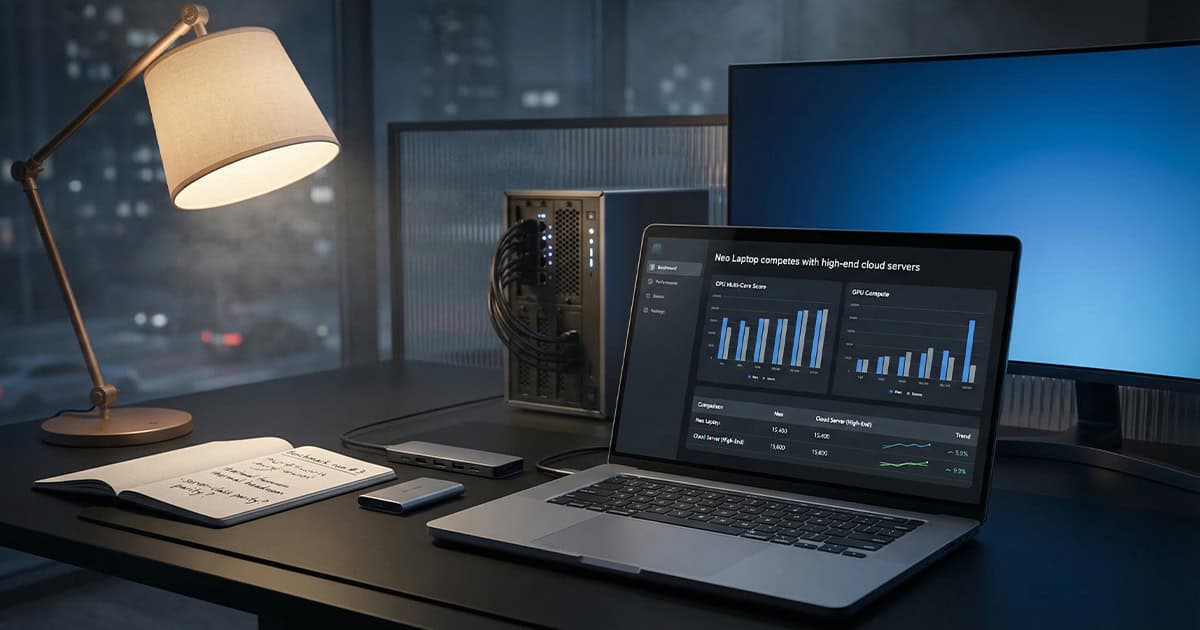
Apple’s MacBook Neo, the company’s newest entry-level laptop, has turned heads in an unexpected way. Recent benchmarks comparing the 512GB MacBook Neo against powerful cloud server instances reveal that this affordable machine can hold its own in demanding database workloads, sometimes outperforming servers with significantly more memory and processing power.
Key Takeaways
- The MacBook Neo outperformed cloud servers with up to four times more RAM in certain database benchmark tests
- In cold run tests measuring initial performance, the MacBook Neo completed queries up to 2.8 times faster than cloud instances
- The laptop’s local NVMe storage provided a significant advantage over network-attached storage used by cloud servers
- While the MacBook Neo eventually fell behind more powerful servers in hot run tests, it remained competitive with mid-sized cloud instances despite having fewer resources
- These results demonstrate how well-optimized hardware and software integration can deliver impressive real-world performance
Testing Apple’s Budget MacBook Against Cloud Computing Power
Gábor Szárnyas from DuckDB conducted an interesting comparison that pitted the MacBook Neo against cloud computing infrastructure designed for heavy workloads. The testing focused on two industry-standard database benchmarks: ClickBench and TPC-DS, both of which simulate real-world data processing scenarios.
The ClickBench benchmark uses 43 queries that focus on aggregation and filtering operations, running on a single table with 100 million rows. This data takes about 14GB when compressed to Parquet format or 75GB as CSV files. The TPC-DS benchmark is even more complex, featuring 24 tables and 99 queries that include sophisticated operations like window functions.
The Competition: MacBook Neo Versus Cloud Instances
The MacBook Neo faced off against two distinct cloud server configurations. The first was a c6a.4xlarge instance featuring 16 AMD EPYC vCPU cores and 32GB of RAM. The second was a substantially more powerful c8g.metal-48xl instance with 192 Graviton4 vCPU cores and 384GB of RAM.
On paper, both cloud instances appear significantly more capable than Apple’s entry-level laptop. The smaller cloud instance has twice the memory of the MacBook Neo’s configuration, while the larger instance boasts four times the RAM and far more processing cores.
Cold Run Results Show Surprising MacBook Neo Performance
Cold run tests measure performance when system caches are empty, simulating a first-time query scenario. Here, the MacBook Neo delivered impressive results, completing all queries in under a minute and finishing up to 2.8 times faster than both cloud instances.
This advantage stems largely from the MacBook Neo’s local NVMe solid-state drive. While the cloud instances rely on network-attached storage, which introduces latency when accessing data, the MacBook Neo reads directly from its internal drive. Even though Apple’s storage solution isn’t the fastest available, the elimination of network overhead provides a meaningful performance boost for this type of workload.
Hot Run Tests Reveal Different Performance Dynamics
Hot run tests measure performance once data is cached in memory, allowing systems to leverage their RAM advantages. This is where the cloud instances began to show their strengths. The powerful c8g.metal-48xl instance completed its hot run in just 4.35 seconds, leveraging its massive core count and memory capacity.
The c6a.4xlarge finished at 47.86 seconds, while the MacBook Neo came in at 54.27 seconds. Interestingly, the MacBook Neo showed only about a 10% improvement between cold and hot runs, suggesting its performance is more storage-bound than memory-bound for this particular workload.
However, looking at median query runtimes rather than total time reveals that the MacBook Neo still competed well with the mid-sized c6a.4xlarge instance. The laptop’s total runtime was only about 13% slower despite having 10 fewer CPU threads and one-quarter the memory.
TPC-DS Benchmark Results Show MacBook Neo Handling Complex Queries
The TPC-DS benchmark tested the MacBook Neo at two scale factors: SF100 and SF300. At SF100, the laptop handled queries comfortably with a median runtime of 1.63 seconds and a total runtime of 15.5 minutes.
At SF300, the more demanding test revealed the MacBook Neo’s memory limitations. The median query runtime increased to 6.90 seconds, and DuckDB occasionally needed to use up to 80GB of disk space for spilling operations when working sets exceeded available RAM. Some queries took considerably longer, with query 67 requiring 51 minutes to complete. Despite these challenges, the MacBook Neo successfully completed all queries in 79 minutes.
What These Benchmarks Mean for Everyday Users
These benchmark results tell an important story about modern computer design. The MacBook Neo demonstrates how tight integration between hardware and software can deliver impressive performance even in an entry-level package. Apple’s approach of designing its own chips and optimizing macOS for those specific processors creates efficiency advantages that help compensate for seemingly modest specifications.
For developers and data professionals working with databases, these results suggest the MacBook Neo can handle substantial workloads without requiring expensive cloud computing resources. The laptop proved particularly effective for initial query development and testing, where cold run performance matters most.
The comparison also highlights how different architectures excel at different tasks. Cloud instances with network-attached storage sacrifice some initial performance but can scale memory and processing power far beyond what a laptop can offer. The MacBook Neo’s local storage provides quick access but can’t match the raw throughput of heavily provisioned cloud infrastructure once data is cached.
Context from Previous A19 Pro Testing
This wasn’t the first time DuckDB has tested Apple’s A19 Pro chip, which powers the MacBook Neo. When the iPhone 16 Pro launched, the team ran the TPC-H benchmark on the device while cooling it with dry ice at minus 50 degrees Celsius. Under those extreme cooling conditions, the phone completed the benchmark run in 478.2 seconds, demonstrating the chip’s capabilities when thermal constraints are removed.
First and Geek Verdict
The MacBook Neo benchmark results remind us that raw specifications don’t tell the complete performance story. Apple’s entry-level laptop punches well above its weight in database workloads, thanks largely to its fast local storage and efficient chip design. While it can’t match the sustained performance of heavily provisioned cloud servers with massive memory pools, it proves surprisingly capable for development work and moderate data processing tasks. For students, developers, and data professionals who need a portable machine that can handle serious work without constantly relying on cloud resources, these benchmarks suggest the MacBook Neo deserves consideration despite its entry-level positioning. The results also demonstrate how important storage architecture remains even as we focus on processor cores and memory capacity.